Memo
Company Orchestrator — The Last Job
AI Chief of Staff. AI Executive Assistant. AI [paste any human job title here]. All doomed to fail.
Giving a human shape to AI is wrong. Not because AI can't do what humans do, but because any human title you give it is a ceiling on something that doesn't have one.
A well-orchestrated AI can consider data points that no single brain can hold at once. Work for more hours no human capable of. Think from entirely different angles just by adjusting its own context. Soak in information from more sources than a person could process in a lifetime. And act across every corner of an organization simultaneously.
No human does all of that. No human title captures it.
We give AI human titles to make it easy for people to understand what our products do. Every one of them undersells it.
Here's the analogy. How many of your friends who bought a new car mentioned its horsepower? The unit was relevant when vehicles started replacing horses. Today it tells you almost nothing. I have no clue what 200 horsepower actually means. Saying your AI is a "chief of staff" is like explaining a Tesla's capabilities in a horse's terms.

And there's a deeper problem: AI will never hold responsibility the way a human title implies. A Chief of Staff is accountable when things go wrong - AI is not. Dressing it in a human title doesn't change that.
Agents shouldn't mirror humans. They should leave the frame entirely.
Fast and Slow.
The world is going to move fast. But much slower than most of us anticipate.
Outside our tech bubble the adoption is lagging. The "AI is about to replace us all" hysteria is largely clickbait. And while it will certainly get there, it will take far more time than it feels from inside the bubble.
Global unemployment barely changed over the most hyped years in tech history. 4.9% in 2025, expected to hold through 2027 [1].
Changes will be incremental. AI replacing humans first on the surface - the most repetitive operations. Then going deeper. Layer by layer, a company becomes increasingly AI-operated. Not overnight. By compounding small wins until the whole thing looks different.
The Interaction.
Avoid direct communication with AI as much as possible.
The first interface was chat. ChatGPT made it mainstream because chat is the most intuitive way for humans to communicate a task. But chatting is slow and lossy. You can rarely transfer your brain's context through a chat window.
To take all the juice out of the AI, you'd need to feed it far more context than any conversation can carry. So instead of a human giving every instruction, AI should act on what already exists - user's digital footprint, the company's data, the tools knowledge workers have been using for years.
AI should be a backstage hero. Do the work. Have everything ready. The human stays in the loop only to review, greenlight, or give feedback. The output shows up inside the tools people already use, in formats they already understand. Not in another new SaaS tool. Not in raw text. Least friction. Least new learning curve.
AI should meet people where they already are - with the work already done.
Most people miss the secondary benefit. No shiny "AI tool" replacing you means no enemy for modern-day Luddites. Users still feel like they are behind their own successful work. That's by design.
So where is all of this going?
Most of an organisation's work can be distilled into small tasks.
Emailing, scheduling, hiring, buying, negotiating, building, researching - a million things that make a company run. AI with the right prompt and context already solves individual tasks well. That's less of a bottleneck now. Orchestrating all of them is.
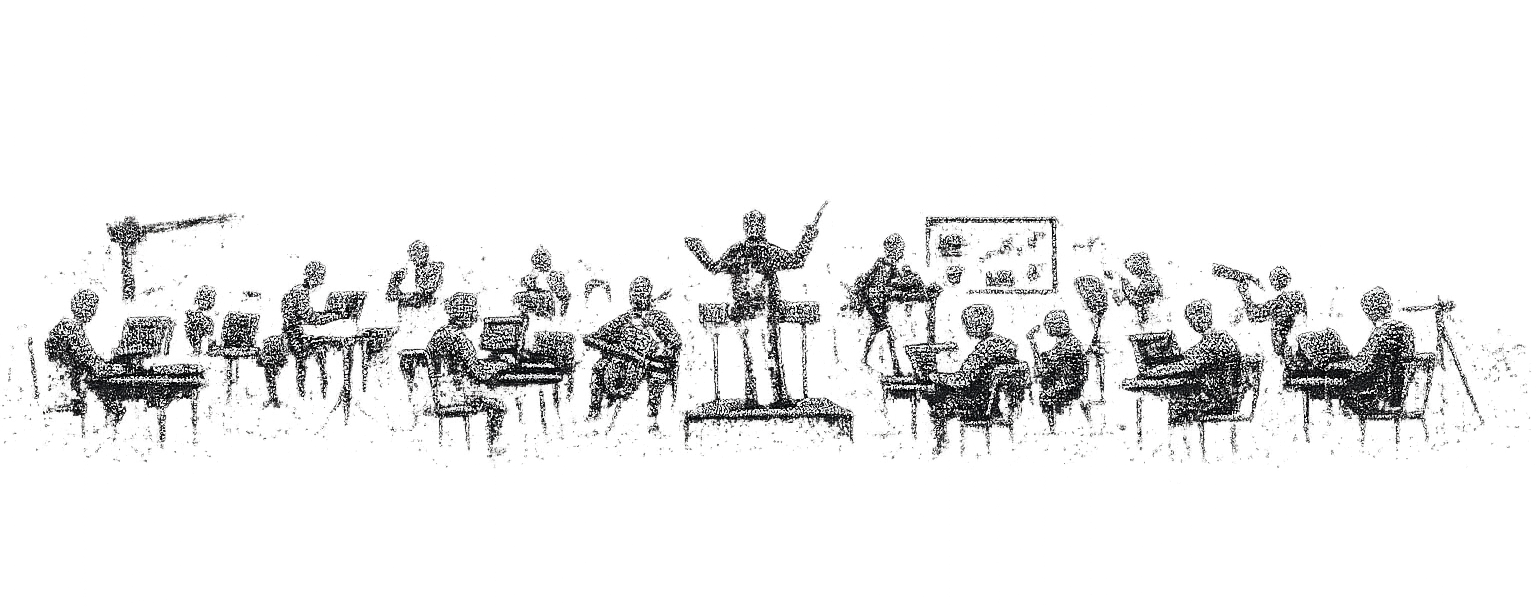
True impact for organisations will come not with the arrival of a mythical AGI - whatever we imagine it to be - but with the ability to orchestrate hundreds of agents towards a company's goal.
Coordinated groups outperformed individuals. Every great achievement in history was done by groups. As Naval put it: "People who don't organize into tribes get wiped out by people who do" [2].
Same is true for agents. Early research supports it - coordination architecture matters more than the intelligence of any single agent [3].
Just as Phil Jackson taking over an NBA team changed its trajectory. Or Ray Dalio starting a fund drawing everyone's attention. A new generation of superstar company operators will emerge. Not today's CEOs. AI-native generalists. The fastest-learning people alive, running dozens of agent operations and getting done what wasn't possible before.
Courage. Taste. Agency. Breadth and depth of mind being the most important qualities to orchestrate it all.
The transition will be gradual for existing enterprises, but existentially important. Startups will be able to act at the scale of today's largest companies and catch up at unprecedented speed.
Sintem is building infrastructure for companies of that future, creating the last job that needs to be invented — The Company Orchestrator.